
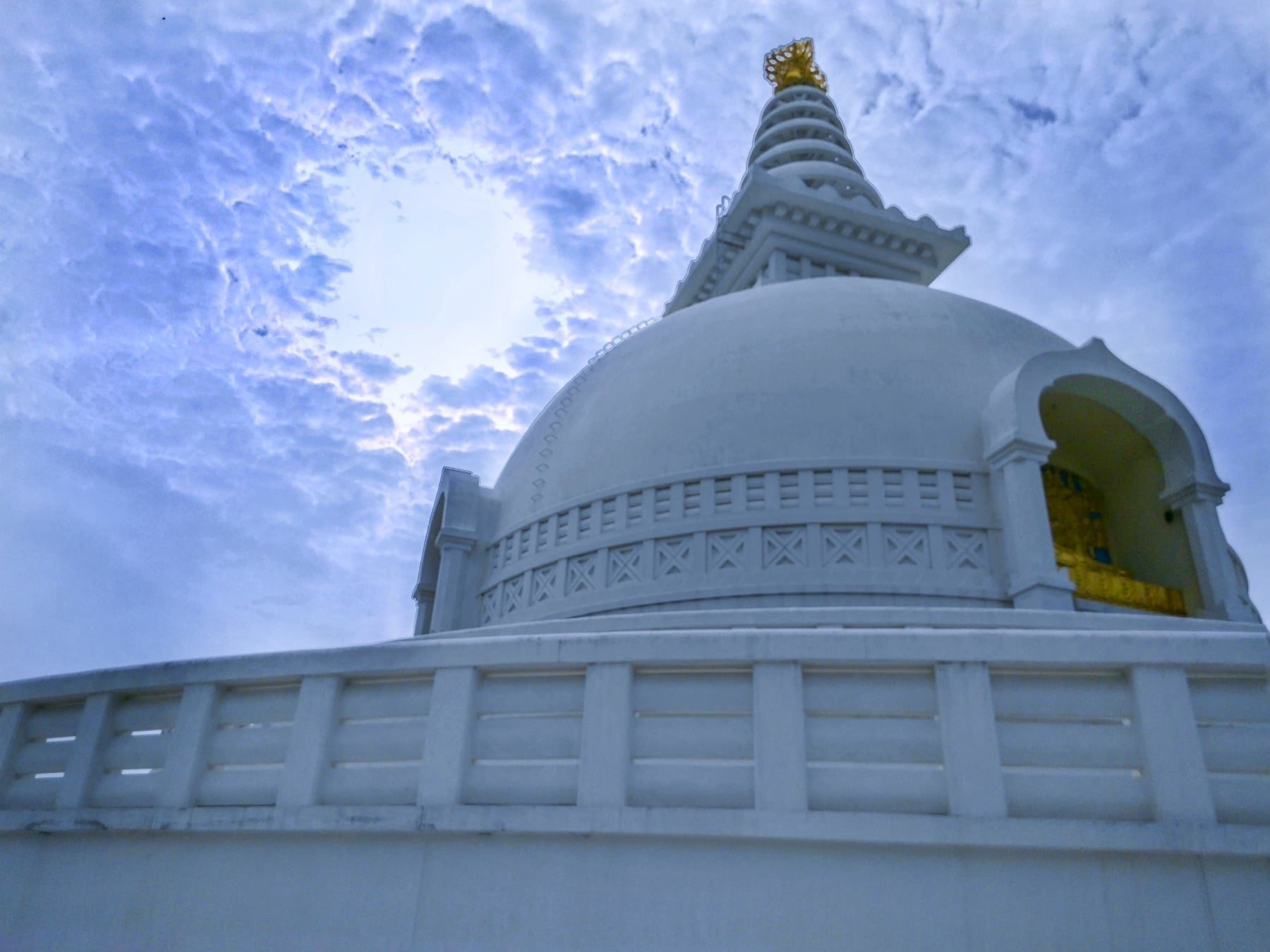
World Peace Pagoda
Built by Nipponzan Myohoji, 2001
- Country
- Japan
- Completed
- 2001
- Reported construction cost
- ~$1M
- Buddha statues, cardinal directions
- 4
Built by the Japanese Buddhist order Nipponzan Myohoji and completed in November 2001, at a reported cost of roughly one million US dollars. The order traces its peace-pagoda tradition to the monk Nichidatsu Fujii, who after meeting Mahatma Gandhi in 1931 devoted the rest of his life to promoting non-violence, and from 1947 began raising Peace Pagodas, of which dozens now stand worldwide, as shrines to that cause. Lumbini’s whitewashed stupa carries four gilded Buddha statues facing the cardinal directions, reached by stairs climbing through three levels, sited not in the Monastic Zone proper but in New Lumbini Village, alongside the Lumbini Museum and Research Institute.
Nichiren Buddhism, turned into a peace movement
Nipponzan Myōhōji traces its teaching to Nichiren, a thirteenth-century Japanese monk who taught that the Lotus Sutra alone contained the complete and sufficient teaching of the Buddha, and centred practice on a single chanted invocation, Namu Myōhō Renge Kyō, “Devotion to the Lotus Sutra”, rather than on meditation or scholastic study. Several distinct modern movements trace back to Nichiren’s teaching, including the much larger lay organisation Soka Gakkai; Nipponzan Myōhōji is a separate, smaller monastic order with its own twentieth-century history.
That history is explicitly pacifist. Its founder, Nichidatsu Fujii, reshaped Nichiren’s teaching after 1931 around active non-violence, following a meeting with Mahatma Gandhi, and from 1947 began building Peace Pagodas, dozens now stand on every inhabited continent, each one raised, in the order’s own practice, to the sound of a hand drum and the same chanted invocation Nichiren taught seven centuries earlier. Lumbini’s pagoda extends that specific twentieth-century lineage to the Buddha’s own birthplace.
The rest of the Sacred Ground
Kenzo Tange’s master plan, and the story of the birthplace itself.