
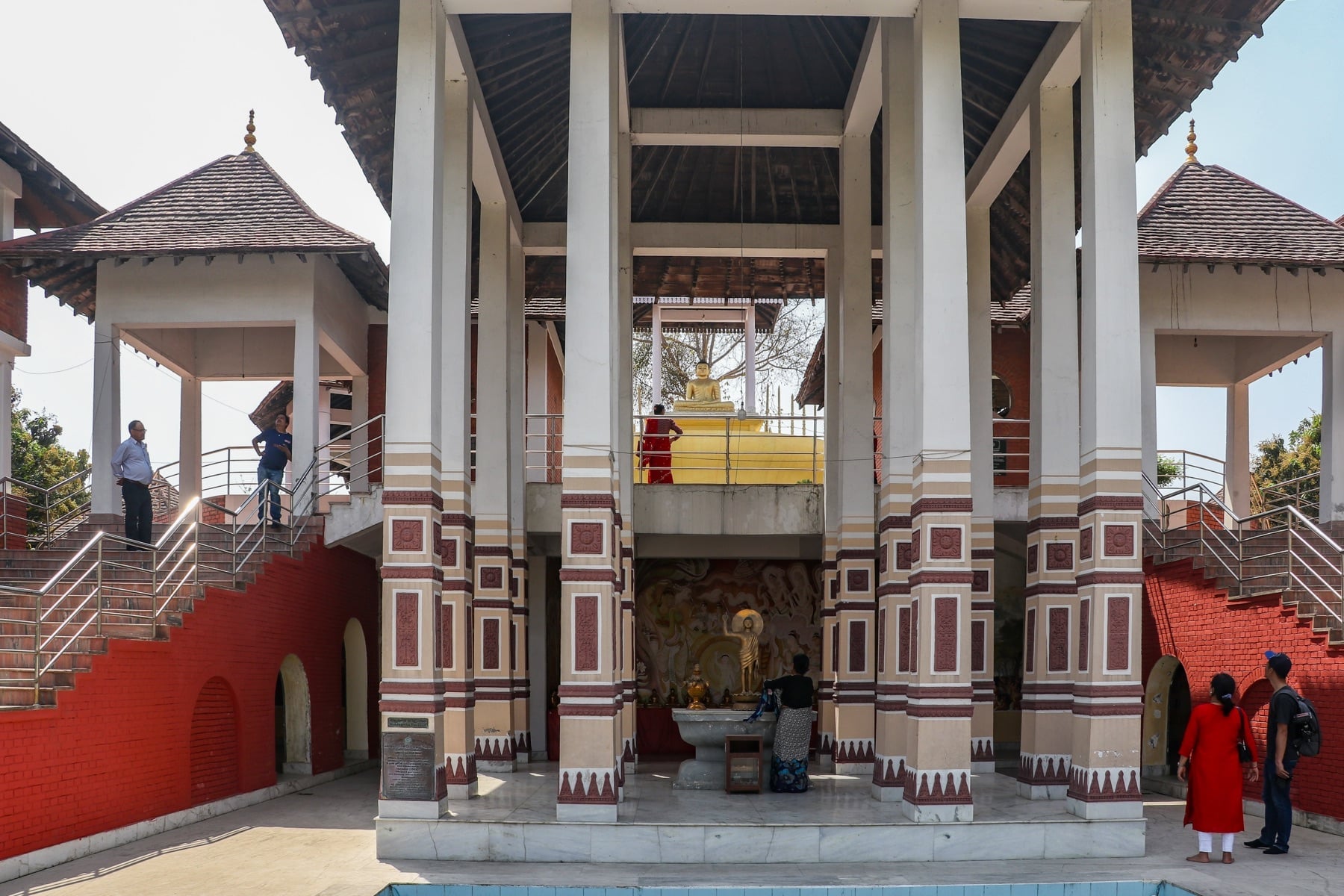
Sri Lankan Monastery
Sinhalese architecture on a moated plot
- Country
- Sri Lanka
- Zone · Theravada
- East
- Architectural tradition
- Sinhalese
- Pavilion layout
- Multi-level
A grand, moated monastery honouring Sinhalese architectural principles, stone-carved pavilions rising across several connected levels, linked by open staircases and ramps, surrounded on most sides by water. Inside, colourful murals trace the life of the Buddha across the walls of its meditation halls, in a style distinct from the Theravada monasteries built by Thailand and Myanmar elsewhere in the same eastern zone, a reminder that "Theravada" itself spans several quite different national visual traditions, all sharing a single doctrinal root.
The oldest unbroken Theravada lineage on earth
Sri Lanka holds a specific claim among Theravada countries: the oldest continuously recorded transmission of the tradition anywhere. According to the island’s own chronicles, the Mahavamsa and Dipavamsa, Buddhism arrived in the third century BCE with the monk Mahinda, by tradition the son of the emperor Ashoka, the same emperor whose pillar stands a few miles from this monastery at Lumbini itself, and whose visit to Ramagrama this site records elsewhere.
That transmission produced the Pali Canon’s own written form: the Fourth Buddhist Council, held in Sri Lanka in the first century BCE, is where the previously oral Tipitaka was first committed to writing, in the Pali language, on palm-leaf manuscripts, the version most Theravada countries still study from today. This monastery’s Sinhalese architecture, distinct from the Thai and Burmese temples either side of it in Lumbini’s eastern zone, is a reminder that “Theravada” names a shared doctrine carried through several quite different national histories, not a single national style.
The rest of the Sacred Ground
Kenzo Tange’s master plan, and the story of the birthplace itself.