
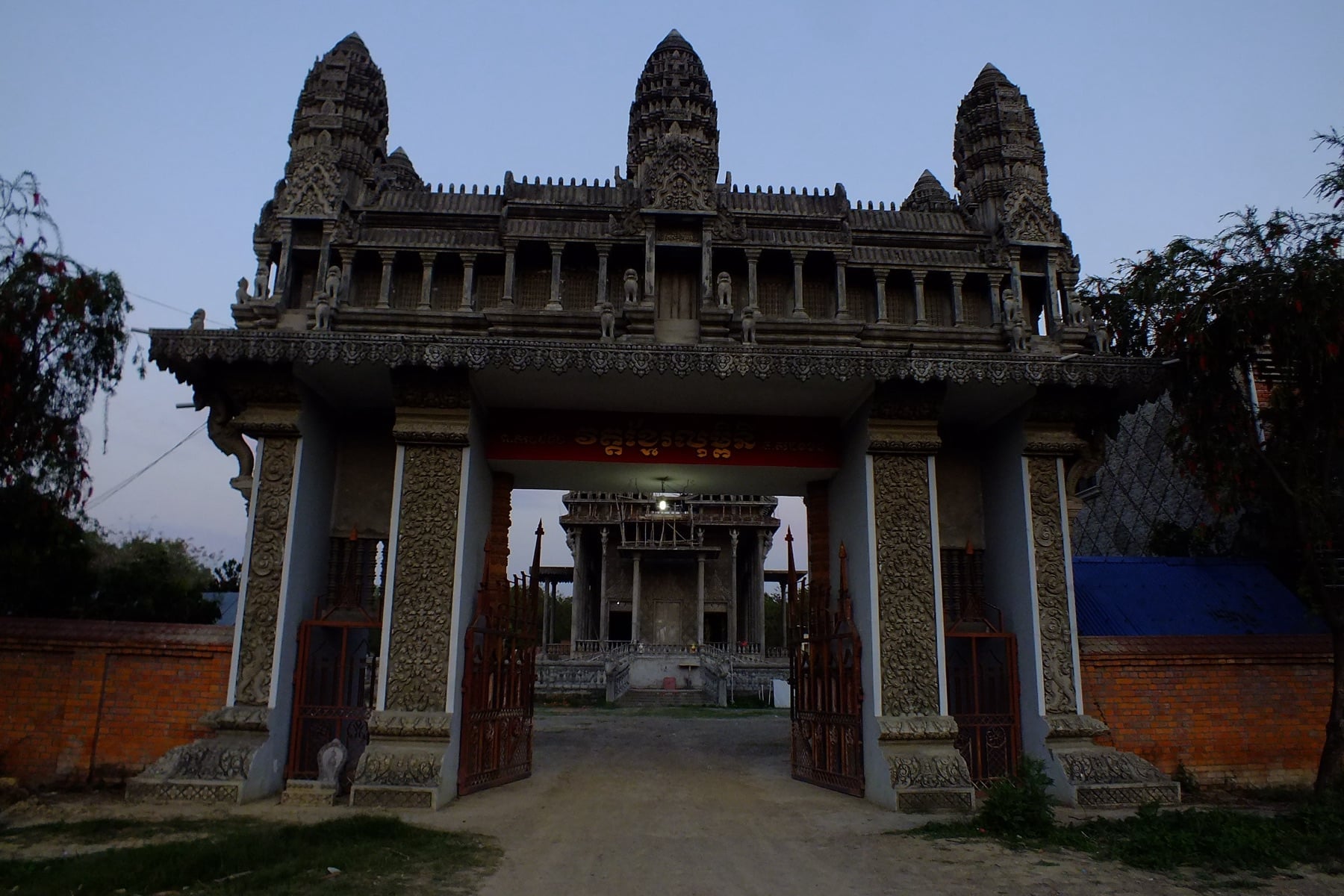
Cambodian Monastery
Angkor Wat’s towers, reimagined
- Country
- Cambodia
- Zone · Theravada
- East
- Architectural reference
- Angkor
- Construction status
- In progress
A monastery built in unmistakable homage to Angkor Wat, its gateway carrying the same tiered, lotus-bud towers and bas-relief ornament as Cambodia’s own national monument, a deliberate act of architectural quotation, carrying one of Southeast Asia’s most recognisable silhouettes into the Nepal Tarai. Construction has proceeded in phases over several years, with the inner halls still being completed behind the finished entrance gate.
A Theravada kingdom, built on older ground
Cambodia’s Theravada Buddhism is, relative to Sri Lanka’s, a comparatively late arrival. Angkor itself, the temple city whose towers this monastery’s gateway quotes so directly, was raised from the ninth century onward primarily as a Hindu monument to Vishnu and Shiva, with Mahayana Buddhist patronage appearing under later kings such as Jayavarman VII. Theravada Buddhism, arriving from Sri Lanka and mainland Southeast Asia, only became Cambodia’s dominant tradition from around the thirteenth and fourteenth centuries, gradually eclipsing the Hindu-Mahayana court religion that built Angkor in the first place.
The monastery’s borrowed silhouette therefore carries a layered history of its own: a Theravada institution, in the same lineage as the Sri Lankan monastery a few plots away, deliberately built in the visual language of a much older, religiously different Cambodian monument, claiming Angkor’s architectural inheritance for a faith that arrived generations after Angkor’s builders had passed.
The rest of the Sacred Ground
Kenzo Tange’s master plan, and the story of the birthplace itself.