
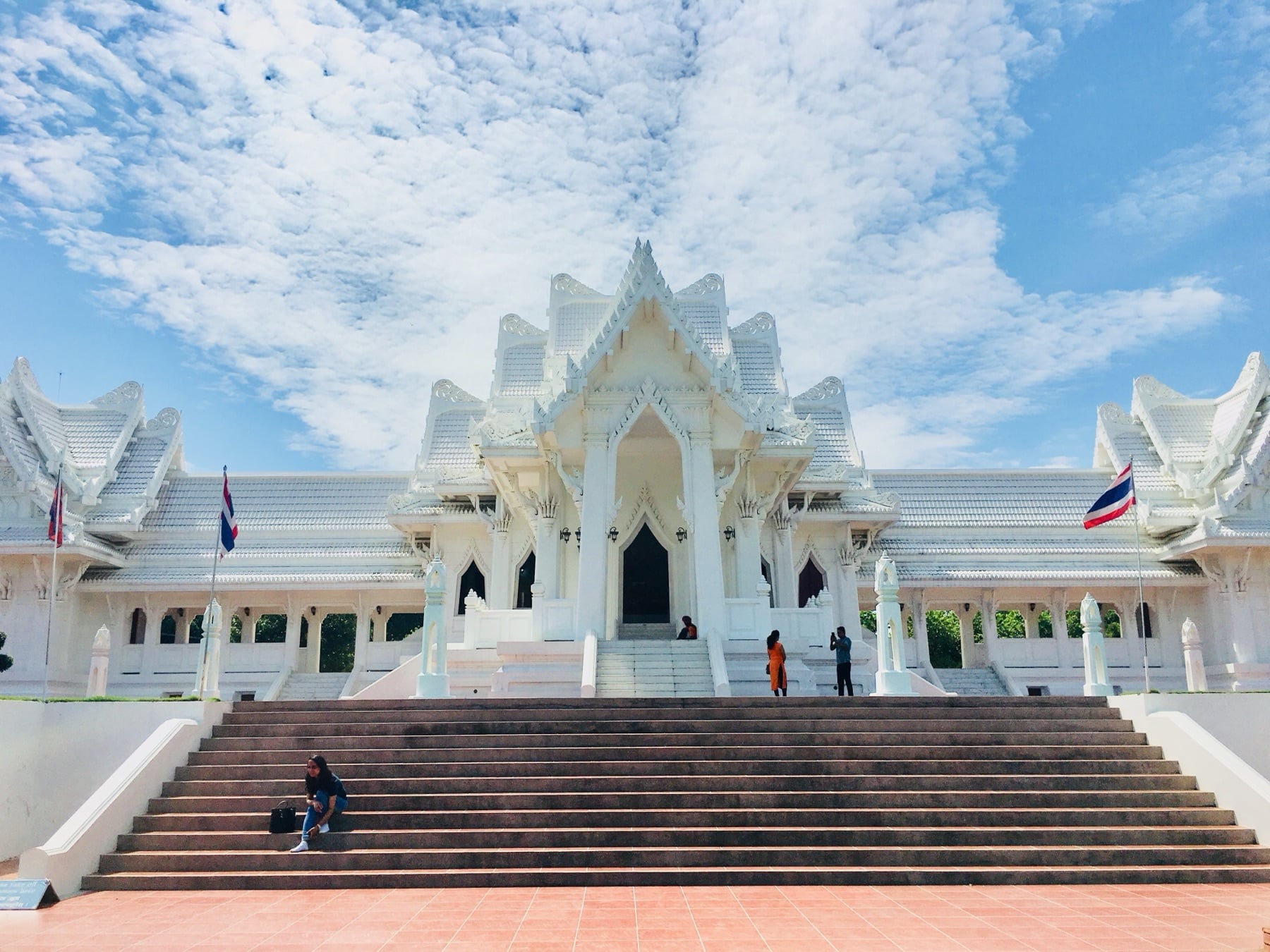
Royal Thai Monastery
A gift from the Royal Thai Government
- Country
- Thailand
- Construction began
- 1997
- Zone · Theravada
- East
- Primary material
- Marble
A gift from the Royal Thai Government and the Thai Buddhist community, built from 1997 in classical Central Thai (Rattanakosin) temple style. The main hall, the ubosot, or ordination hall, is constructed almost entirely of white Rajasthani marble, its multi-tiered red-and-gold roof rising to golden finials (cho fah) above ornately carved gables. Inside sits a large golden Buddha in bhumisparsha mudra, the earth-touching gesture, flanked by murals depicting the Jataka tales, the traditional stories of the Buddha’s past lives. A separate blue-roofed meditation centre stands alongside the main hall, and the monastery hosts daily chanting and periodic retreats open to visitors by arrangement.
Thai Theravada, ordained on consecrated ground
Thailand’s Buddhism belongs to the Theravada school, the “Teaching of the Elders,” the branch that holds closest to the Pali Canon, the earliest complete record of the Buddha’s own teaching, and to the Vinaya, the code of monastic discipline he is recorded as having laid down himself. Thai monks ordain within the Thai Sangha, the kingdom’s national monastic order, which has stood under royal patronage since the Sukhothai kingdom of the thirteenth century, the same relationship between crown and cloth that funded this monastery seven centuries later, on ground three thousand kilometres from Bangkok.
Every element of the ubosot answers to that discipline. Its floor is set over consecrated boundary stones, or sema, marking the one patch of ground where an ordination is ritually valid, a rule observed here exactly as it would be at home. Around it, the relationship between monastery and public runs on merit: lay Buddhists earn punna by giving dana, alms and support, to monks who in turn preserve and teach the doctrine, an exchange this temple, standing far from any Thai congregation, was built specifically to keep open for pilgrims passing through.
The rest of the Sacred Ground
Kenzo Tange’s master plan, and the story of the birthplace itself.