
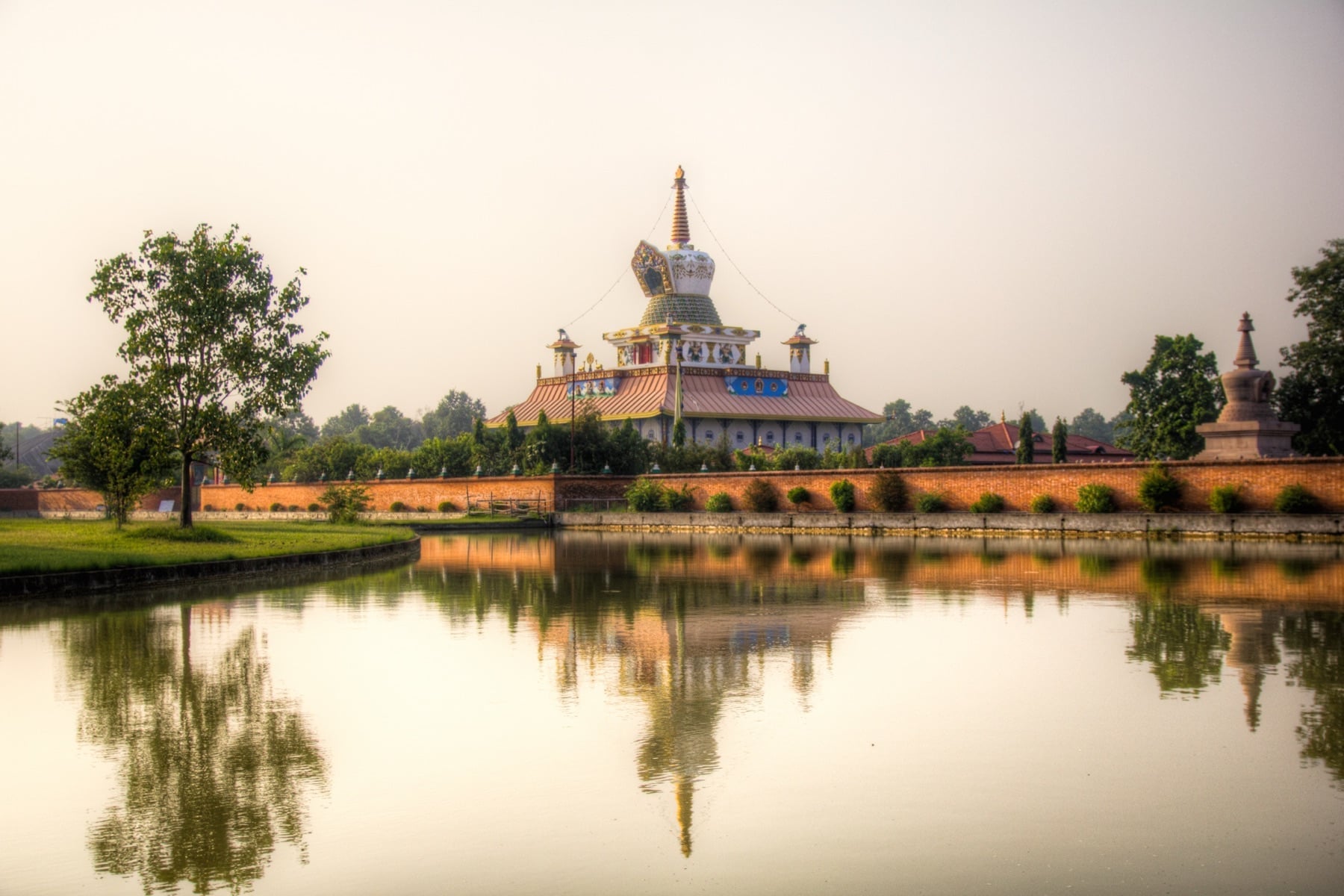
Great Drigung Kagyud Lotus Stupa
The only German-built monastery in Lumbini
- Country
- Germany
- Project conceived
- 1999–
- Zone · Vajrayana
- West
- Lease, plot WB4
- 99yr
One of the few monasteries in Lumbini built by a European country. The idea came in 1999 from Ferdinand Rinchen Phuntsok, director of the German Tara Foundation, at the suggestion of his teacher Venerable Drubpon Sonam Jorphel Rinpoche, spiritual director of the Drigung Kagyud Dharmaraja Foundation; a 99-year lease on plot WB4, on the western side of the Monastic Zone, followed. The stupa’s crown is partly glazed, revealing a Buddha image inside rather than concealing it, and its domed ceiling is painted with murals whose iconographic programme traces back to the writings of the Tibetan scholar Rigzin Choskyi Drakpa, a design that treats the building itself as a teaching text, meant to be read as much as entered.
The Kagyu lineage, carried oral teaching to oral teaching
Kagyu means, roughly, “lineage of oral transmission”, a school of Tibetan Buddhism built less around a single founding text than around an unbroken chain of teacher-to-student instruction, traced back to the Indian tantric masters Tilopa and Naropa, carried to Tibet in the eleventh century by the translator Marpa, and passed from Marpa to his student Milarepa, Tibet’s most celebrated poet-yogi, whose songs of realisation are still studied throughout the Kagyu world.
Drigung Kagyu, the specific branch that built this stupa, is one of several sub-schools descending from that root lineage, founded in 1179 by Jigten Sumgön at Drigung Monastery in central Tibet. It is known in particular for its transmission of phowa, the practice of consciously directing consciousness at the moment of death, and for a strong pilgrimage tradition, both of which sit naturally behind a monastery built, as this one explicitly was, as a reliquary stupa rather than a temple hall: a building whose entire form is meant to be circumambulated, not merely entered.
The rest of the Sacred Ground
Kenzo Tange’s master plan, and the story of the birthplace itself.