
Niglihawa
Birthplace of Kanakamuni Buddha · Rediscovered 1895
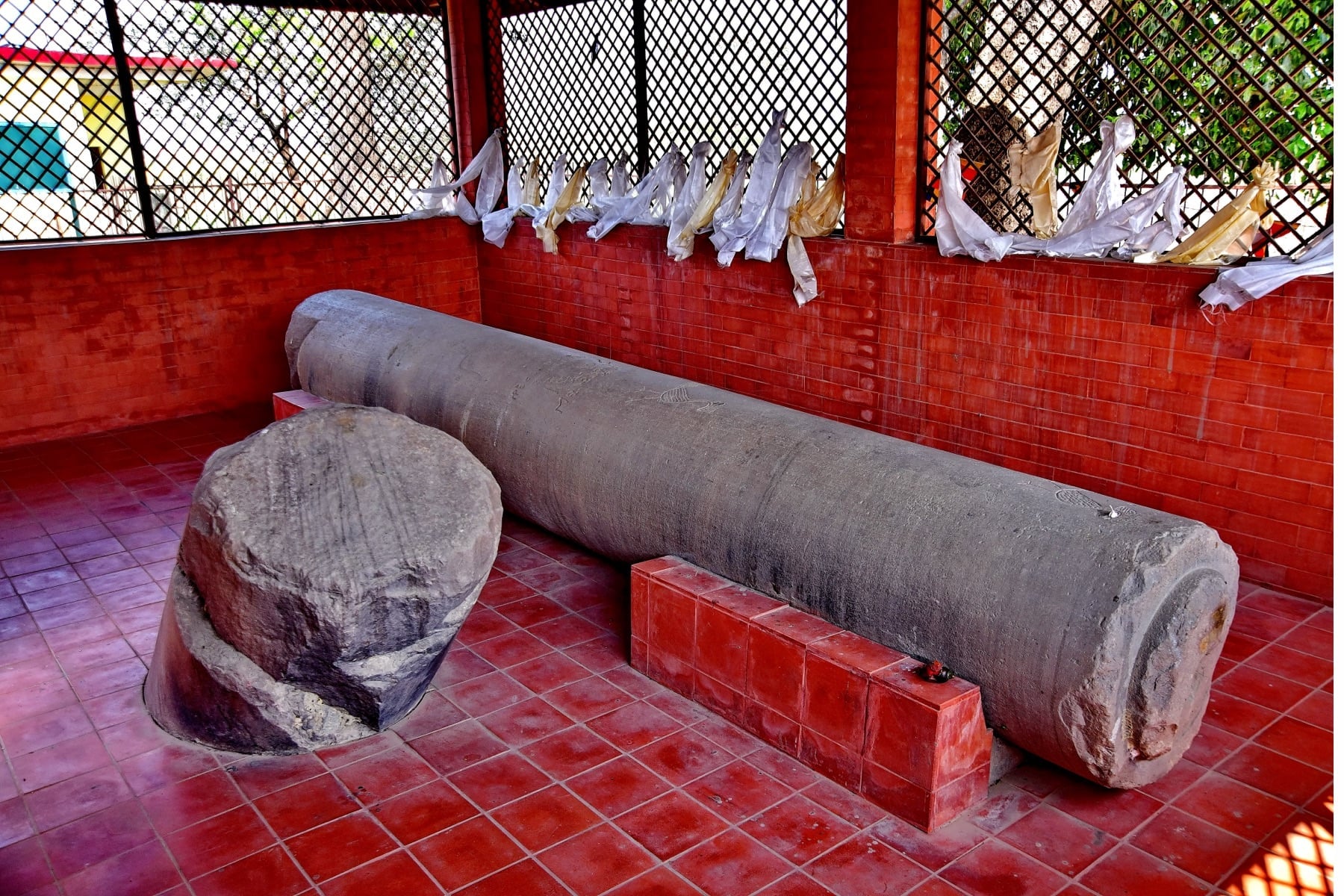
Identified as the birthplace of Kanakamuni Buddha, some seven kilometres northeast of Taulihawa. Ashoka’s own pillar here, rediscovered by Dr. A. A. Führer in 1895, records in Brahmi and Pali that he personally enlarged Kanakamuni’s stupa and worshipped it in the twentieth year of his reign, the same formula, on the same imperial tour, that produced the Lumbini pillar’s inscription. In 1312 CE the same king who inscribed that Lumbini pillar, Ripu Malla, carved his own line of homage onto this one too: “Om Mani Padme Hum, Sri Ripu Malla, may he live long.” Niglihawa and Lumbini are, on present evidence, the only two Ashokan pillars in Nepal to carry both a third-century-BCE imperial inscription and a fourteenth-century royal one, two rulers, sixteen centuries apart, choosing the same stone. The pillar survives today broken into two pieces.
From tradition and the ground
Ashoka enlarges the stupa
The Brahmi inscription records that in the twentieth year of his reign Ashoka came in person, enlarged the stupa of Kanakamuni for a second time, and set up this pillar. It is one of the earliest uses anywhere of the word “stupa” in an inscription.
Ripu Malla’s prayer
In 1312 CE the Malla king Ripu Malla added his own line in Devanagari: “Om Mani Padme Hum, Sri Ripu Malla, may he live long.” The same king left his name on the Lumbini pillar, suggesting a deliberate pilgrimage route between the two birthplaces.
The pilgrims’ accounts
Fa-Hien, travelling in the early fifth century, wrote of a pillar and stupa here. Xuanzang, two centuries later, described a lion capital and noted that the Buddha Kanakamuni had been born in the town. Their reports confirmed the site for later archaeologists long before Führer rediscovered it.
View of the site
The story behind the stones
Kanakamuni, the second of the three Buddhas tradition places in this stretch of the Tarai, is said to have been born here to a Brahmin family before his renunciation and awakening. As with Krakuchhanda, most of what is known comes from Ashoka’s own act of pilgrimage and inscription rather than a surviving narrative, the emperor’s pillar is, in effect, the earliest biography Kanakamuni has.
Niglihawa, Kapilvastu, Nepal
The stupa that was never opened
Ramagrama, the ninth site, and the one none of Ashoka’s successors ever disturbed.