
Araurakot
Where Kanakamuni grew up · 9 associated sites mapped
The fortified, moated town where Kanakamuni Buddha is said to have lived, grown up and married, a large rectangular citadel roughly nine kilometres northeast of Tilaurakot, its ramparts and moat still readable in the field despite centuries with no formal excavation. A joint Nepali–Italian archaeological team identified nine associated sites in the surrounding area in 1996–97, and a later UNESCO-led survey, carried out with the Department of Archaeology and Durham University, has since mapped extensive structural ruins buried beneath the citadel itself using geophysical survey rather than the spade, a site, on the current record, still more mapped than excavated, and one of the circuit’s clearer candidates for future fieldwork. What a visitor finds on the ground today is largely the moat and rampart itself, a rectangular earthwork enclosing heaps of unexcavated ruin, quiet fields standing over a town whose interior has not yet been opened to the trowel.
From tradition and the ground
The moated town
From the air, Araurakot appears as a perfect rectangle of earthworks, its moat still holding water in places. The shape is that of a planned ancient city, yet no gate, no street, no house interior has been exposed by modern archaeology.
A life-site without excavation
If Niglihawa marks Kanakamuni’s birth, Araurakot is said to mark his adult life, the place where he lived as a householder before renunciation. The pairing mirrors Lumbini and Tilaurakot for Shakyamuni, but here the “life-site” remains sealed underground.
Nine satellite sites
A 1996–97 survey mapped nine associated mounds and water features around the citadel, suggesting that Araurakot once sat at the centre of a dispersed sacred landscape rather than as an isolated fort.
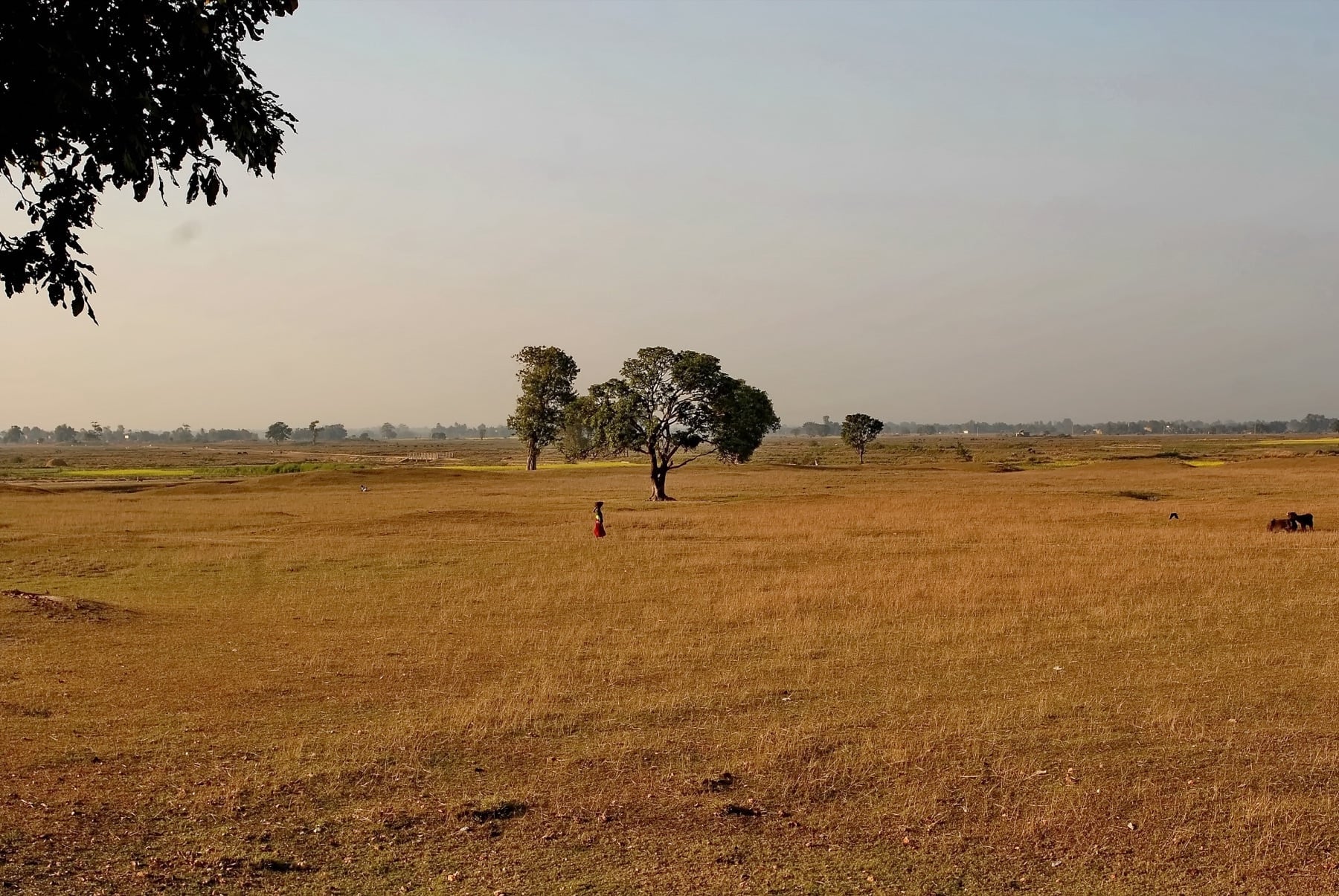
View of the site
The story behind the stones
Where Niglihawa marks Kanakamuni’s birth, Araurakot is remembered as the place of his adult life, tradition holding that he was raised, married and lived out his household years within this moated town before his own renunciation. The pairing of a birth-site and a life-site, a few kilometres apart, mirrors the same pattern the circuit later repeats for Shakyamuni himself at Lumbini and Tilaurakot.
The stupa that was never opened
Ramagrama, the ninth site, and the one none of Ashoka’s successors ever disturbed.