
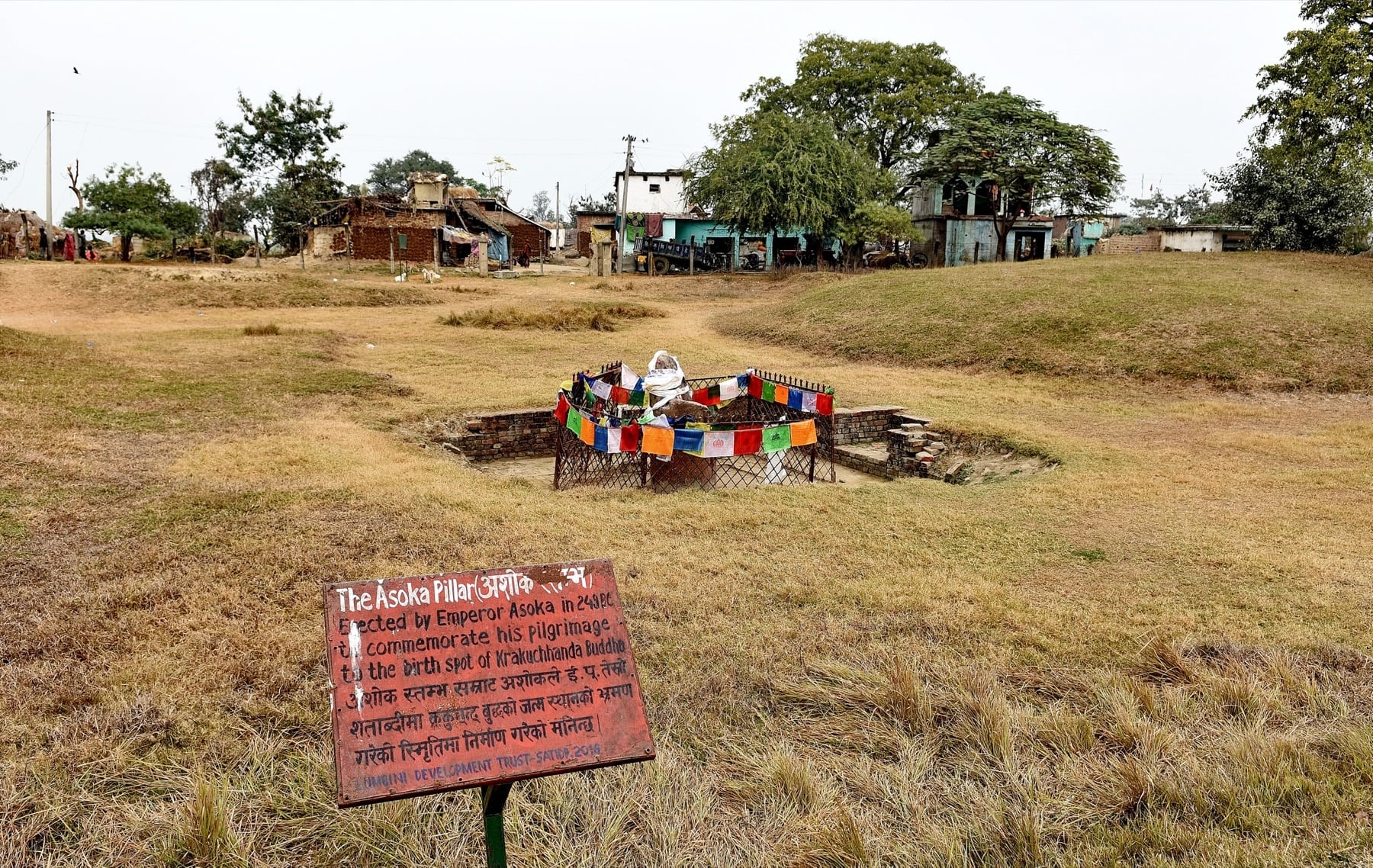
Gotihawa
Birthplace of Krakuchhanda Buddha · Ashoka pillar, 249 BCE
Identified in Buddhist tradition as the birthplace of Krakuchhanda Buddha, one of the Buddhas held to have preceded Shakyamuni. Ashoka raised a stone pillar here in 249 BCE to mark the spot; what survives stands 3.25 metres tall on its original masonry base, 83 by 79 centimetres across, its inscribed, lion-topped capital broken off and never recovered, though the Chinese pilgrims Fa-Hien (399–413 CE) and Xuanzang (636 CE) both recorded seeing it whole. A joint Nepali–Italian excavation in 1993 found evidence of human activity spanning the tenth or ninth century BCE through the third or fourth century CE, nearly a millennium and a half of continuous presence at a single spot. The pillar and its surrounding ground remain in fragile, weathered condition today, among the least visited of the circuit’s nine sites despite carrying one of its oldest confirmed dates.
From tradition and the ground
Ashoka’s pillar
On his twentieth-regnal-year pilgrimage in 249 BCE, Emperor Ashoka travelled through the Tarai marking the sacred sites of earlier Buddhas. At Gotihawa he erected a polished sandstone pillar to honour Krakuchhanda’s birth, one of the oldest dated monuments still standing in Nepal.
The missing capital
Fa-Hien and Xuanzang both described a complete pillar crowned with a lion. The capital is gone today, broken off and lost, so the pillar now ends abruptly above its inscription. Its absence is a reminder of how much ancient ornament has simply disappeared from these sites.
Three Buddhas, one land
The Buddhavamsa names Krakuchhanda as the twenty-fifth in the line of Buddhas. Together with Kanakamuni at Niglihawa and Shakyamuni at Lumbini, the Nepal Tarai is the only landscape on earth where tradition places the births of three separate Buddhas.
View of the site
The story behind the stones
Krakuchhanda is named in Theravada tradition as the twenty-fifth of the twenty-nine Buddhas, the first of the three Buddhas, alongside Kanakamuni and Shakyamuni, said to have appeared in this one stretch of the Nepal Tarai. Little narrative detail survives about his life; what remains is almost entirely archaeological, which makes Gotihawa a rare case on the circuit, a site whose significance rests on Ashoka’s third-century-BCE act of commemoration more than on any surviving story of its own.
The stupa that was never opened
Ramagrama, the ninth site, and the one none of Ashoka’s successors ever disturbed.