
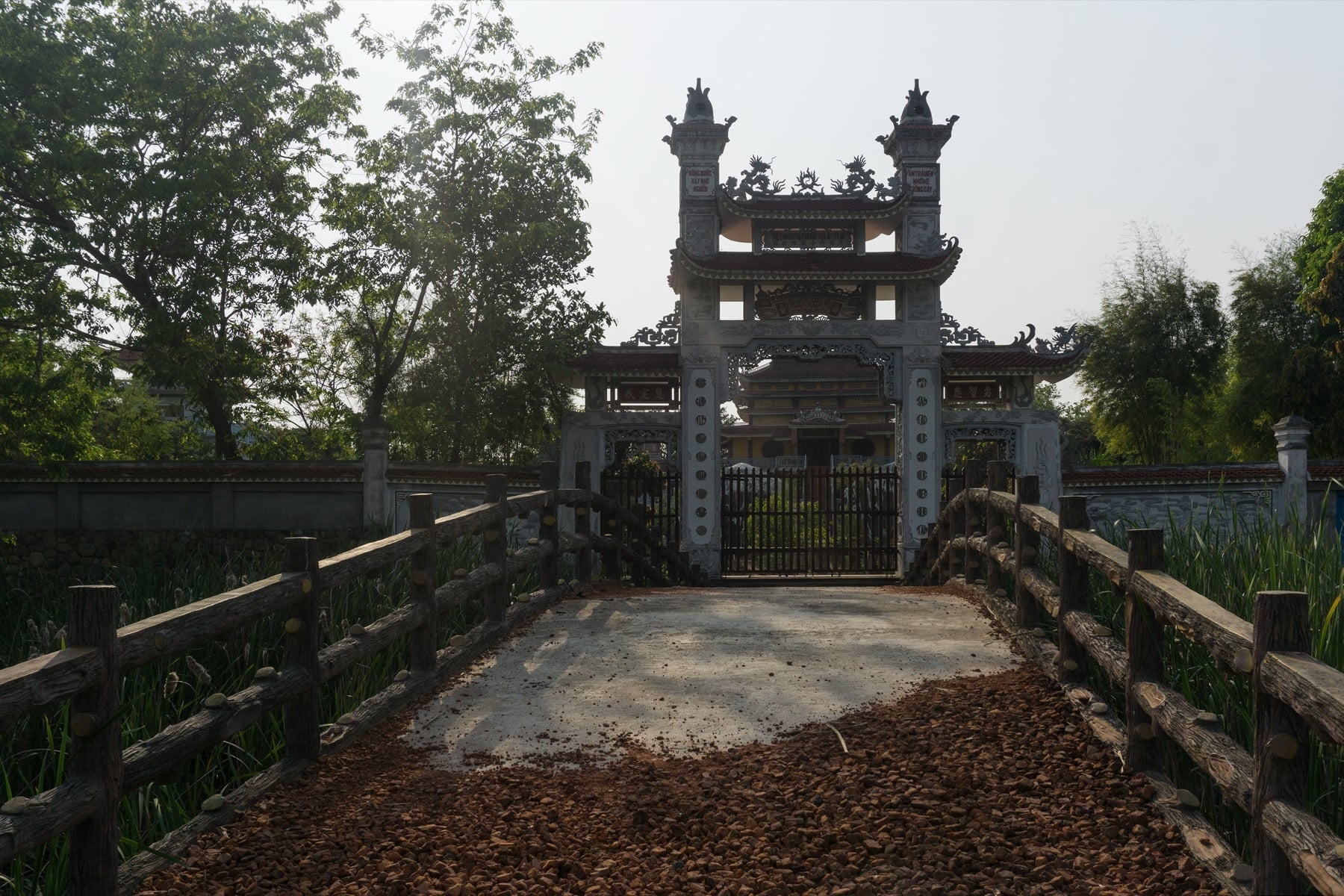
Vietnam Phat Quoc Tu
A gateway framed by artificial mountains
- Country
- Vietnam
- Zone · Mahayana
- West
- Architectural tradition
- Vietnamese
- Approach & grounds
- Landscaped
One of the few structures anywhere that represents the diplomatic and religious relationship between Vietnam and Nepal, its ceremonial gateway carved with dragons in the northern Vietnamese temple tradition and flanked by artificial rockwork landscaping meant to evoke a mountain approach, a designed sense of pilgrimage distance compressed into a short walk from gate to hall. The complex draws Vietnamese pilgrims travelling the Buddhist circuit as part of a wider devotional journey through Lumbini, Bodh Gaya, Sarnath and Kushinagar.
Vietnamese Thiền, and a lineage born of a king
Vietnamese Buddhism is Mahayana, shaped by Thiền, Vietnam’s own branch of the Chan/Zen meditation lineage, layered together with Pure Land devotion and, distinctively, Confucian ancestor veneration, in a blend some scholars describe as Vietnam’s true folk religion rather than a single imported school. Two lineages matter most to its history: Lâm Tế, descended from the Chinese Linji school that also produced Japanese Rinzai Zen, and Trúc Lâm, a native Vietnamese school with no foreign parent at all.
Trúc Lâm is unusual among the world’s Buddhist lineages for its founder: Trần Nhân Tông, a reigning Vietnamese emperor who in 1299, after leading his country’s armies to defeat two Mongol invasions, abdicated the throne to become a monk and found a specifically Vietnamese school of Zen on Yên Tử Mountain. The dragon-carved gateway raised here, and the artificial mountain approach behind it, echo that same national synthesis of statecraft and monastic renunciation, architecture built to represent a country, not only a religion.
The rest of the Sacred Ground
Kenzo Tange’s master plan, and the story of the birthplace itself.